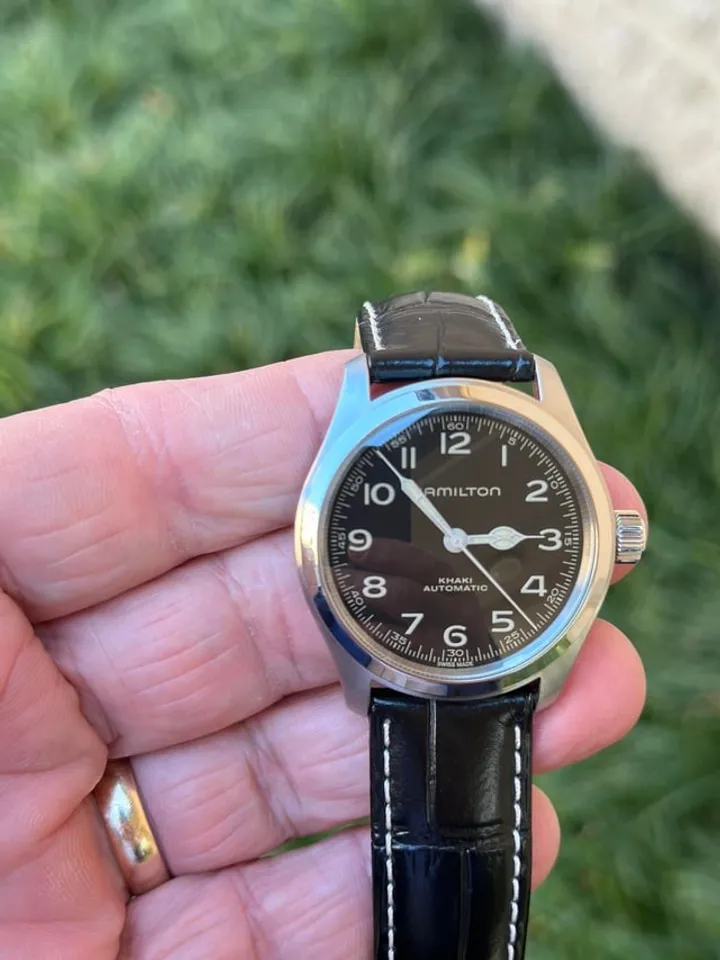
Why this watch matters
The Hamilton Khaki Field Murph retails at $795 for the 38mm (case diameter) version and $895 for the 42mm version. That puts it in a tier where the competition is serious, the spec sheets are dense, and the marketing is loud. The Murph cuts through that noise in an unusual way: it has a story.
Hamilton is a Swiss-made brand owned by the Swatch Group, which means it shares movement architecture with Tissot and ETA-based alternatives. That is worth naming plainly, because it shapes what you are actually buying. The American-heritage identity Hamilton carries, rooted in supplying field watches to the US military from World War II onward, is genuine. But the manufacturing address is Biel, Switzerland, not Lancaster, Pennsylvania. Neither fact cancels the other out. They just need to be held together.
The Murph specifically was designed for Christopher Nolan’s film Interstellar (2014), where it appears as the watch Cooper gives his daughter Murph before leaving on his mission. That connection is not incidental to the price. It is part of the price. If the film means nothing to you, that is a real consideration, and the section on comparisons addresses what else $795 to $895 buys.
What the film connection produced, though, is a dial with a coherent reason to exist. The full-dial Arabic numeral layout, the cathedral hands (the distinctive pointed, multi-stepped hand shape), the dark khaki-coloured numerals, and the seconds hand engraved with the word “Eureka” in Morse code are not random design choices. They trace back to Hamilton’s wartime field watch heritage and to specific narrative moments in the film. That combination of historical grounding and deliberate storytelling is rare at this price point.
The watch is also genuinely easy to buy. No waitlist, no relationship with an authorised dealer (AD) required, no allocation games. You can walk into a Hamilton AD, try both sizes on your wrist, and leave with one the same day. In a market where some watches at this price require months of patience and a purchase history with a retailer before you are offered the model you want, that frictionless access is worth noting without overstating it.
Owner sentiment
The strongest and most consistent signal from owners is about size. The 38mm version, with a lug-to-lug (the distance from the tip of one lug to the tip of the opposite lug, which determines how far the watch extends across your wrist) of 48mm (1.89in), is the version most people end up preferring after trying both. The 42mm version’s lug-to-lug of 52mm (2.05in) overhangs smaller wrists noticeably, and the lugs on the larger case curve less aggressively as they extend outward.
One owner described trying the 42mm first and finding it “absolutely hideous” on their wrist because of the long lugs and poor dial visibility. When they tried the 38mm, something clicked. The proportions worked. The watch became a daily fixture in a way the larger version never could have been. Another owner with a 7.75-inch (19.7cm) wrist bought the 42mm, kept it, then bought the 38mm. The 42mm now sits in a drawer.
The Interstellar connection runs deep for a significant portion of owners, and it does not feel performative in the way film tie-in merchandise often does. One owner who spent three years wanting the watch described finding three of them in a New York display case as a moment they could not walk away from. They had been collecting everything connected to the film, from posters to props, and the watch was the piece that completed it. Another first-time buyer who knew almost nothing about watches bought the Murph purely because of the film, then went deep into the hobby and acquired two more watches within months. The Murph, they wrote, remained their favourite.
The strap versatility is a recurring theme. Owners describe the Murph pulling off NATO (a through-the-lug fabric strap style originating from NATO military specifications), leather, rubber, and mesh straps with equal ease. One owner put it plainly: it can be dressed down to read like a vintage World War II field watch or dressed up to pass at a formal dinner. That range is unusual for a watch with such a specific aesthetic.
The movement accuracy draws consistent praise. Owners report the H-10 calibre running within COSC (Contrôle Officiel Suisse des Chronomètres, the Swiss precision certification standard, which requires accuracy within minus 4 to plus 6 seconds per day) tolerances in practice, with one owner noting it “loses very little time” over extended daily wear.
The weaknesses are just as consistent, and they deserve the same weight.
The AR (anti-reflective) coating on the crystal is the most widely cited complaint. Multiple owners describe the dial becoming a mirror in direct sunlight, with a distorted reflection of their face competing with the watch face. One owner put it plainly: “a beautiful watch you cannot always read is a frustrating watch.” It is worth noting that Hamilton states the 38mm version does include AR coating, while the 42mm does not, but even owners of the 38mm report the glare as a real issue. The coating that is present is thin.
The absence of a date complication creates genuine friction for daily wear. After nearly two months of wearing the Murph as a GADA (go-anywhere, do-anything daily watch) piece, one owner realised they had been reaching for their date-equipped Seiko Presage for anything work-related. The no-date dial looks clean in photographs. In practice, if you have built a habit around checking the date on your wrist, that habit does not disappear because the watch is beautiful.
The lume (luminescent compound applied to hands and numerals to allow reading in low light) is mediocre relative to the ambition of the dial. The full-dial Arabic numeral layout means there is a large surface area to illuminate. The compound applied does not keep pace with that. One owner who wears the watch daily pushed back directly on claims of “great lume”: their experience was that it is poor. A separate owner described it as “trash,” while still loving the watch overall. Those are two separate facts, and both are true.
Expert perspective
The dial layout that some critics call cluttered has a defence that goes beyond aesthetics. Hamilton field watches have looked this way since World War II. The full-dial Arabic numerals, the dense minute track, the utilitarian symmetry: these are not design affectations borrowed from the film. The Murph’s dial is a direct continuation of a functional tradition, and the film’s production team chose Hamilton precisely because that tradition was already there.
The movement is the H-10 calibre, which is based on the ETA A31.L11 platform. ETA is the Swatch Group’s movement manufacturing arm, and the H-10 shares its architecture with movements found in Tissot and other Swatch Group brands. That shared lineage is a practical advantage: parts are widely available, service knowledge is distributed across a broad network of watchmakers, and the movement has a long track record. Compared with a similarly priced Christopher Ward (CW) watch running an SW-200 movement, the H-10 offers a meaningful spec advantage: accuracy within COSC tolerances, an 80-hour power reserve (the length of time the watch runs from a full wind without being worn), and stronger resistance to magnetic fields. Christopher Ward’s case finishing is generally considered superior at this price point. The Murph’s movement credentials are stronger. Both things are true simultaneously.
The seconds hand carries “Eureka” in Morse code, referencing the moment in the film when the character Murph solves the gravitational propulsion equation. It is a detail that rewards close inspection without announcing itself to anyone who does not know the film. That kind of restraint is harder to execute than it looks.
The film tie-in does inflate the retail price relative to comparable spec watches. This is not a contested point. One long-term owner acknowledged it directly: the Murph is too expensive for what it is on a pure spec-per-dollar basis, the AR coating is inadequate, and the included leather strap is underwhelming. They still love the watch. The pre-owned market reflects the premium clearly: lightly used examples sell for approximately $350 to $500 USD, against a retail price of $795 to $895. That implies a resale rate of roughly 40 to 60 percent of purchase price. The Interstellar connection does not protect value meaningfully. If you are buying this watch and expecting to recover most of your outlay when you sell it, the data does not support that expectation.
The push-pull crown (a crown that pulls out in one or two positions to set the time, rather than screwing down to seal against water pressure) and the bracelet’s limited micro-adjustment positions are real ergonomic compromises for a watch positioned as an everyday piece. The push-pull crown is not a water resistance problem at 100 metres (10 ATM), but it is a daily-use friction point that screw-down crown alternatives at this price do not have. The bracelet clasp offers only two micro-adjustment positions, which means some wrists will not find a comfortable fit without moving to an aftermarket strap.
Hamilton service intervals are typically quoted at 5 to 7 years, with service costs ranging from approximately $200 to $400 USD depending on the service centre and the work required (Hamilton’s own authorised service pricing and independent watchmaker estimates vary; get a quote before committing, as these figures are not fixed). That is a real cost to factor into a decade of ownership, and it applies regardless of whether you buy new or pre-owned.
Common comparisons
Hamilton Khaki Field Auto vs. Hamilton Khaki Field Murph
The Khaki Field Auto (KFA) uses the same H-10 movement and shares the Murph’s core field watch proportions. It retails for less, carries less hype, and is available in sizes that suit a wider range of wrists. One owner who chose the KFA over the Murph described the decision simply: “everything about this watch makes sense, cheaper than the Murph too because less hype around it, same movement I believe.” If the Interstellar connection is not part of your reason for buying, the KFA is the more honest value proposition. The Murph’s specific dial, cathedral hands, and Morse code seconds hand are what you are paying the premium for.
Hamilton Khaki Field Murph vs. Christopher Ward C65 Trident
Christopher Ward (CW) is a British direct-to-consumer brand that competes directly with Hamilton at this price point. The C65 Trident starts at around $795 USD and offers superior case and dial finishing compared with the Murph, with a more refined surface treatment and greater variety in finishing depth. The Murph’s H-10 movement has the edge on power reserve (80 hours versus the SW-200’s 38 hours) and magnetic resistance. CW does not have the same AD walk-in availability; it is primarily purchased online, which removes the ability to try before buying but also removes the retail markup. If finishing quality is your primary criterion, CW is the stronger choice. If movement credentials and in-person purchase matter more, the Murph holds its ground.
Hamilton Khaki Field Murph vs. Seiko Alpinist (SPB117, SPB119)
The Seiko Alpinist retails at approximately $500 to $600 USD and addresses two of the Murph’s confirmed weaknesses directly: the AR coating is better, and the lume is stronger. The Alpinist also includes a date complication and an internal rotating bezel (a bezel that turns inside the crystal, used for tracking elapsed time or a second time zone). The movement, Seiko’s 6R35, offers a 70-hour power reserve. The Alpinist’s dial aesthetic is entirely different, drawing from Japanese mountaineering heritage rather than American military history. If practical daily legibility is your priority and the Murph’s specific aesthetic is not essential, the Alpinist is a serious alternative at a lower price.
Hamilton Khaki Field Murph vs. Sinn 556
The Sinn 556 starts at approximately $1,500 USD, which puts it above the Murph’s price band, but it is the comparison that comes up most often when owners discuss the AR coating problem. Sinn’s AR coating is consistently cited as among the best in the industry at any price, and the 556 series addresses the Murph’s legibility weakness directly. The Sinn is a German-made watch with a more industrial aesthetic and no film connection. If you are considering the Murph primarily as a daily wearer and the reflection issue concerns you, the Sinn 556 is the constructive alternative worth pricing out before you commit.
Overall take
The Hamilton Khaki Field Murph is a $795 to $895 automatic field watch with a Swatch Group movement, a 100-metre (10 ATM) water resistance rating, and a dial design that traces a direct line back to Hamilton’s World War II military contracts. It is not a neutral purchase. The Interstellar connection is baked into the price, and if that connection means nothing to you, there are watches at this price point, from Christopher Ward, Tissot, and several microbrands, that offer better finishing or a more practical feature set for the same money.
What the Murph does well is harder to quantify on a spec sheet. The full-dial Arabic numeral layout, cathedral hands, and faux-patina lume create a coherent visual identity that very few watches at this price match. The movement, Hamilton’s H-10 calibre based on the ETA A31.L11, runs to approximately plus or minus 4 seconds per day in practice, carries an 80-hour power reserve, and is serviced by any Hamilton-authorised watchmaker. Hamilton service intervals are typically quoted at 5 to 7 years, with costs ranging from roughly $200 to $400 USD depending on the service centre and the work required (Hamilton’s own service pricing and independent watchmaker estimates vary; get a quote before committing). That is a real cost to factor in over a decade of ownership.
The two weaknesses are not minor. The AR coating on the sapphire crystal is thin enough that direct sunlight turns the dial into a mirror, and the lume, while covering a large surface area, does not charge or glow with the intensity the dial’s ambition suggests. Neither flaw makes the watch unwearable, but both are documented consistently enough across owner reports that you should treat them as confirmed specifications rather than edge-case complaints. If legibility in all conditions is your primary criterion, the Sinn 556 series (starting around $1,500 USD) or a Seiko Alpinist (around $500 to $600 USD) address both issues more directly.
If you are considering the pre-owned market, the value case is stronger but the risks are distinct. Platform risk varies by where you buy: established platforms like Chrono24 or WatchBox offer buyer protection that private sales on forums or social media do not. Seller risk is separate: even on a reputable platform, individual seller history and return policies differ, and a watch listed as “excellent condition” may have undisclosed service history or crystal scratches. Authentication risk for the Murph specifically is lower than for high-demand watches like Rolex or Patek, because the incentive to produce convincing fakes is smaller at this price point, but it is not zero. Lightly used examples sell for approximately $350 to $500 USD. That is a meaningfully better value proposition than retail, and the movement’s serviceability means a used example with unknown service history is not a significant gamble if you budget for a service inspection.
On size: try both before buying if you can. The 38mm (1.50in) version with a 48mm (1.89in) lug-to-lug is the right choice for most wrists up to about 7 inches (18cm). The 42mm (1.65in) version with a 52mm (2.05in) lug-to-lug is the screen-accurate size and suits wrists of 7.5 inches (19cm) or larger. The community evidence on this is unusually consistent.
If the Murph’s specific aesthetic is what you are after, buy it knowing those trade-offs, and budget for a quality aftermarket strap, because the included leather strap is the weakest component in the box.