How to Authenticate a Pre-Owned Watch Before You Buy
Key takeaways
- Most fakes fail at multiple checkpoints: Super-rep counterfeits exist, but the majority of fraud a first buyer encounters fails obvious tests, wrong caseback, shallow rehaut engraving, gritty crown feel.
- Three outcomes, not a checklist: Every inspection maps to Proceed, Request a service report, or Walk away, knowing which condition triggers which outcome is what makes this actionable.
- An exhibition caseback on a Rolex Submariner is an instant walk-away: No genuine modern Submariner has a display caseback; if you see one, leave without negotiating.
- A $50–$150 pre-purchase watchmaker inspection is non-negotiable above $2,000: On any private-seller purchase over that threshold, the inspection cost is under 5% of the price and is the single most reliable authentication tool available to a non-expert.
- Genuine and original-configuration are not the same thing: A franken-watch built from real parts passes most authentication checks but trades at a 20–40% discount, and a watchmaker’s inspection is the only reliable way to catch it.
You’ve found a pre-owned Rolex Submariner on Chrono24. The price looks right. The photos look clean. The seller has decent feedback. Before you transfer $3,800, you want to know it’s real.
This piece gives you a triage workflow. It won’t make you a watchmaker. It will help you catch the fakes most first buyers encounter, know when to bring in a professional, and recognise exactly when to walk away.
What self-authentication can and cannot do
Start here, because this matters: a high-quality counterfeit, the watch community calls them “super-reps”, can fool a non-expert on a casual inspection. The finishing on the best fakes has improved significantly in the last five years. If someone has spent real money producing a convincing replica of a $5,000 Submariner, a first-time buyer looking at photos is not going to catch it on dial font alone.
That’s not a reason to skip this process. It’s a reason to understand what the process actually does.
Most fakes are not super-reps. Most counterfeits fail at multiple checkpoints: the crown feels wrong, the rehaut engraving is shallow, the caseback has an exhibition window it shouldn’t. The workflow here catches the majority of fraud a first buyer will encounter. It also tells you when the watch is ambiguous enough that you need a professional before you commit.
Every inspection in this piece maps to one of three outcomes:
Proceed. All checks pass. The watch is consistent with a genuine example. Buy with normal due diligence.
Request a third-party service report. Something is off but not disqualifying. Get an independent watchmaker to inspect the watch before you hand over money. This costs $50–$150 and takes 24–48 hours. It is worth it on any purchase above $1,500.
Walk away. A specific condition is present that no legitimate watch should have. Do not negotiate. Do not ask for an explanation. Leave.
These three outcomes appear throughout the piece. By the end, you’ll have a clear map of which observations lead where.
Before you see the watch: reference verification
The first round of authentication happens before you’re anywhere near the watch. You need a reference number, a serial number, and a seller willing to provide both.
Finding the serial and reference numbers
For Rolex, the serial number on modern references (post-2005) is engraved on the rehaut, the inner ring of the dial, and is also visible between the lugs at 6 o’clock when the bracelet is removed. On references produced from approximately 2002 onwards, the rehaut also carries continuous laser-engraved text reading “ROLEX ROLEX ROLEX” around its full circumference. Ask the seller for a photo of the rehaut. If they can’t provide one, that’s a flag.
For Omega, the serial number is engraved on the caseback.
For Tudor, the serial number sits between the lugs, consistent with Rolex practice.
The reference number is typically on the caseback or between the lugs. On Rolex, it appears between the lugs at 12 o’clock.
Cross-checking the serial number against the stated year
Rolex serial numbers follow a date range. A watch sold as a 2018 example should have a serial number consistent with 2018 production. Community-maintained resources and Rolex’s official specifications page let you cross-reference this. A serial number that falls two or more years outside the stated production year is a red flag. It doesn’t automatically mean the watch is fake, casebacks get swapped, paperwork gets separated, but it requires an explanation.
Reference number and configuration matching
This is one of the most reliable remote checks available, and sellers who have assembled fake listings often get it wrong.
The Rolex Submariner ref. 124060 is a no-date model: no date window at 3 o’clock, no cyclops lens on the crystal. The ref. 126610LN has a date complication and a black ceramic bezel insert. If a listing describes a “Submariner 124060” and the dial photos show a date window, the reference number and the watch do not match. That is an immediate walk-away condition.
Learn the configuration of the specific reference you’re buying before you contact any seller. Fratello Watches’ Submariner and Black Bay reference guides are a reliable starting point.
Listing red flags
These conditions are visible before you’ve seen the watch in person:
- Price more than 20% below the current Chrono24 market rate for the same reference and condition grade. A deal that looks too good usually is.
- Listing photos are stock images or manufacturer press photos rather than photos of the actual watch.
- Seller won’t provide photos of the movement or caseback when asked.
- Serial number is absent from the listing and the seller declines to share it.
A price more than 30% below market rate, combined with any of the above, is a walk-away condition without further investigation.
In-person inspection: what to check and in what order
If the remote checks pass, you’re ready to see the watch. Bring two things: a 10x loupe (available on Amazon for $15–$30) and a phone with a macro camera. A saved reference sheet of the specific model’s known specifications is also worth having.
Work from the outside in. Start with what you can see without tools, then use the loupe.
Case finishing
On a genuine Rolex Submariner, the transition between brushed and polished surfaces is sharp and clean. The brushed flanks of the case meet the polished chamfers at a precise line. On fakes, this transition is typically blurred, the polishing bleeds into the brushed surface, or the brushed texture is too coarse.
On the Omega Seamaster Professional 300M, look at the case flanks. Genuine examples have a consistent, fine brushed finish with polished bevels that hold their geometry. Fakes often show uneven brushing or bevels that widen and narrow inconsistently.
On the Tudor Black Bay 58, the case bevels are a known weak point for counterfeits. Genuine examples have sharp, consistent bevel angles. Fakes frequently show soft or uneven transitions, visible under a loupe. Fratello Watches’ hands-on Black Bay coverage documents the genuine finishing standard in detail.
Dial inspection
Use the loupe here. You’re looking at four things:
Font consistency. The brand name, model name, and “Swiss Made” text at the bottom of the dial should be crisp and consistent in weight. Fakes frequently have slightly wrong font weights or letter spacing. Compare against a reference photo of a confirmed genuine example.
Lume plot alignment. The luminous material in the hour markers should be centred and consistent across all indices. Under a loupe, genuine applied indices sit flush with the dial surface. Fakes often show glue residue around the base of the index, or slight misalignment that’s invisible to the naked eye but obvious at 10x.
Applied index adhesion. Press gently on an applied index with a fingernail. On a genuine watch, it doesn’t move. On a fake, you may feel slight give. Don’t do this aggressively, you’re checking for obvious looseness, not trying to damage the watch.
Dial text depth. On genuine dials, printed text has a consistent depth and finish. Fakes often show text that looks slightly raised or has inconsistent ink coverage under magnification.
Crown and winding feel
A genuine Rolex Triplock crown has three distinct detent positions: fully screwed down, unscrewed and at rest, and pulled out to the winding and setting positions. The transition between positions is positive and deliberate. Winding resistance is smooth and consistent.
A fake crown often feels loose in the screwed-down position, or gritty when winding. The detent positions may be vague or absent. This is one of the easiest tactile checks to run and one of the most reliable.
Bracelet and clasp
On a genuine Rolex Oyster bracelet, the clasp text, “ROLEX OYSTER” and the reference engravings, is laser-engraved. The engraving is crisp and sits cleanly in the metal. The clasp folds with a solid, non-rattling action. The links feel substantial.
On counterfeit bracelets, the clasp text is typically stamped rather than engraved. It looks shallower and less precise under a loupe. The links often feel hollow or rattle slightly when shaken. The clasp action may feel loose or imprecise.
Caseback
This is where some fakes make their most obvious mistake.
A genuine Rolex Submariner, both the ref. 124060 and the ref. 126610LN, has a plain, solid screw-down caseback. There is no exhibition window. There is no display of the movement. If the watch in front of you has a caseback with a glass window showing the movement, and it is being sold as a Rolex Submariner, walk away. This is a non-negotiable walk-away condition.
The Omega Seamaster Professional 300M (ref. 210.30.42.20.01.001) is different. It has a display caseback, and you should be able to see the movement. What you’re looking for is the co-axial escapement, a distinctive three-wheel escapement mechanism that replaced the traditional lever escapement in Omega’s movements. If the seller claims this is a genuine modern Seamaster but the movement visible through the caseback lacks the co-axial wheel, it is not a genuine modern Seamaster. Ask to see the caseback before you commit.
Movement observation
Where the movement is visible, look at the rotor finish and the engravings on the movement bridges. Genuine movements have consistent, high-quality finishing. Engravings are crisp. The rotor swings freely and smoothly.
A movement that looks rough, has inconsistent finishing, or has engravings that look stamped rather than engraved is a flag. You may not be able to identify the specific calibre by sight, but you can identify a movement that looks wrong.
Brand-specific tells: Rolex Submariner, Omega Seamaster, Tudor Black Bay
Generic advice, “check the logo, check the finishing”, doesn’t give you enough to work with. These three references are the most counterfeited in the $1,500–$5,000 range. Each has specific weak points that fakes consistently get wrong.
Rolex Submariner (ref. 124060 / 126610LN)
The rehaut engraving. On all Submariner models produced from approximately 2002 onwards, the rehaut carries continuous laser-engraved text: “ROLEX ROLEX ROLEX” around the full inner circumference of the bezel ring. Hodinkee’s Submariner reference history coverage documents when this feature was introduced. On genuine examples, the engraving is fine, consistent, and clearly legible under a loupe. On fakes, it is frequently shallow, inconsistent in depth, or absent entirely. This is one of the most reliable single checks for a modern Submariner.
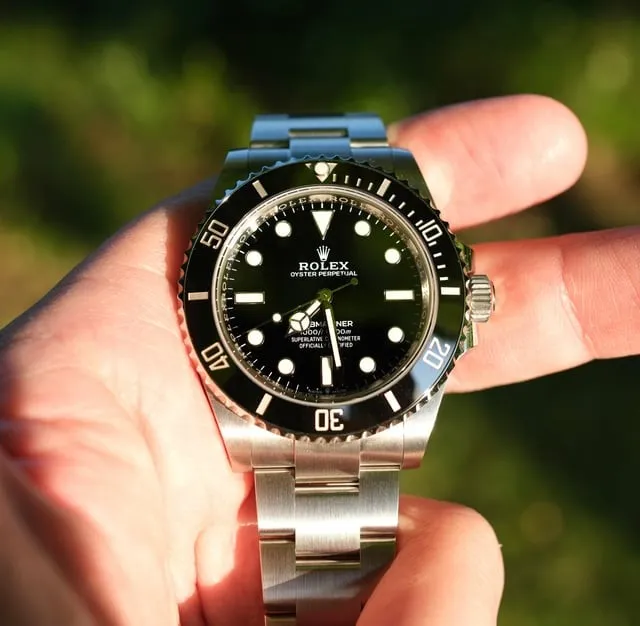 The rehaut engraving on a genuine post-2002 Submariner is fine, consistent, and legible under a loupe. Shallow or absent text is one of the most reliable single tells on a fake. Credit: u/Drrhizome
The cyclops lens. On the date-equipped 126610LN, the cyclops lens over the date window magnifies at 2.5x and sits flush with the edge of the crystal. Fakes are often under-magnified, the date looks smaller than it should, or the lens sits slightly proud of the crystal surface. Compare against a reference photo.
The caseback. Plain, solid, no exhibition window. No exceptions on any genuine modern Submariner.
Omega Seamaster Professional 300M (ref. 210.30.42.20.01.001)
The wave-pattern dial. The horizontal wave pattern on a genuine Seamaster 300M dial has a fine, consistent texture. Under a loupe, the waves are precise and evenly spaced. Fakes typically render this pattern as either too coarse, the waves are too wide and obvious, or too uniform, lacking the subtle variation of the genuine dial. Compare against a confirmed genuine example photo before your inspection.
The co-axial escapement. Through the display caseback, you should be able to identify the co-axial escapement. If you’re not sure what you’re looking at, search “Omega co-axial escapement” before your inspection and familiarise yourself with the visual. A movement that lacks this feature in a claimed modern Seamaster 300M is not a genuine modern Seamaster.
Tudor Black Bay 58 (ref. M79030N)
The snowflake hand. Tudor’s snowflake hour hand is a signature design element and a known fake weak point. On a genuine Black Bay 58, the snowflake hand has a specific rectangular lume-filled cutout at the tip. The lume fill is clean and sits flush with the hand surface. On fakes, the cutout shape is often slightly wrong, too rounded, too narrow, or asymmetric, and the lume fill is frequently uneven or shows air bubbles under a loupe.
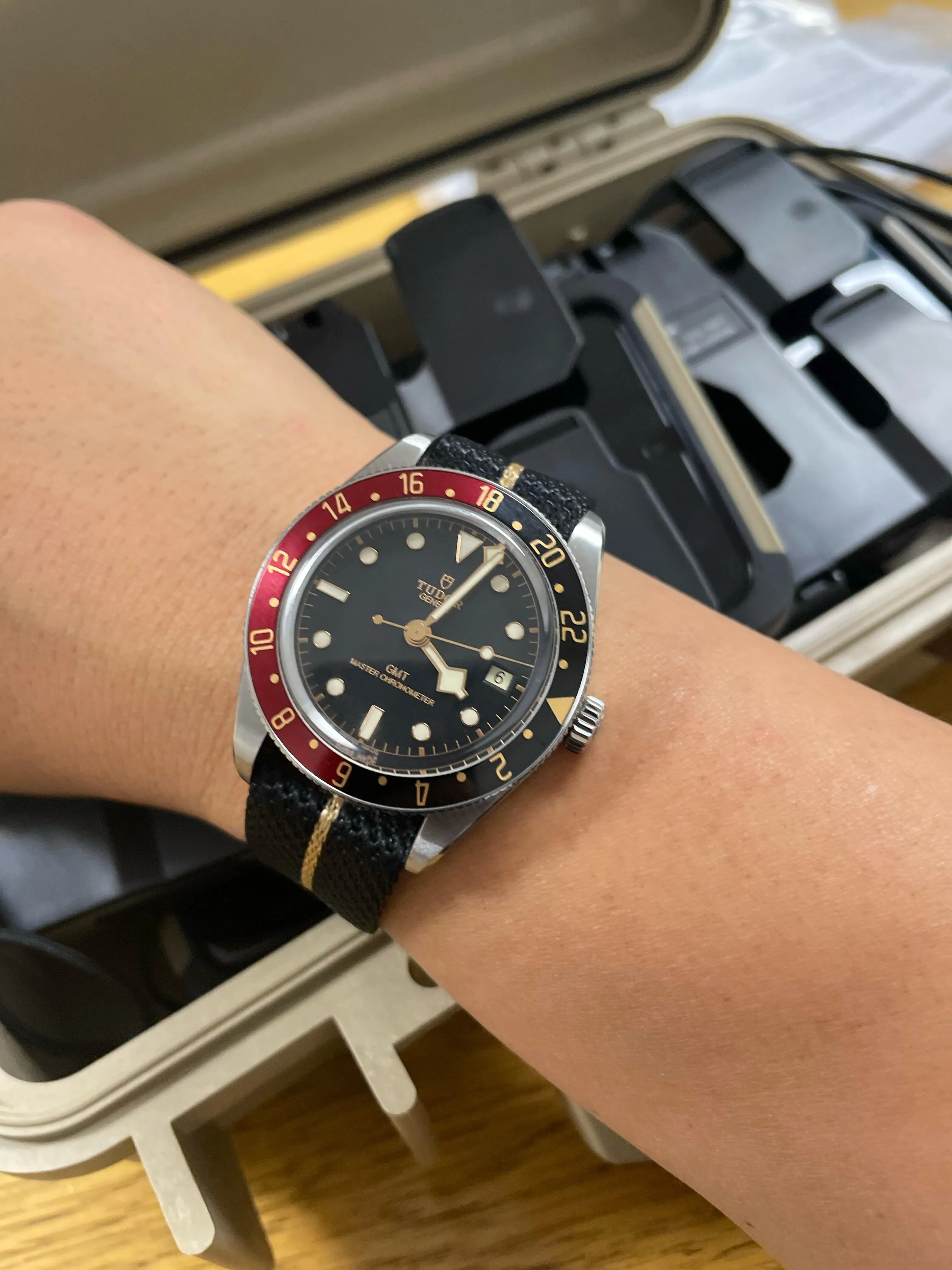 The snowflake hand’s rectangular lume cutout is one of the most counterfeited details on the Black Bay 58. On a genuine example the fill is clean, flush, and symmetrical. Credit: u/Carlodelucis
The dial font. The “TUDOR” text on the dial uses a specific font weight. Fakes frequently use a slightly bolder or lighter version. Compare against a reference photo from Fratello Watches’ Black Bay 58 coverage before your inspection.
The decision tree: proceed, request a service report, or walk away
Here is where the checklist becomes a decision. Map what you’ve observed to one of these three outcomes.
Walk away, no negotiation
If any single one of these conditions is present, leave:
- Exhibition caseback on a claimed Rolex Submariner (any reference).
- Serial number falls more than two years outside the date range for the stated production year, with no explanation.
- Reference number does not match the dial configuration (e.g., a claimed 124060 with a date window).
- Seller refuses to provide movement or caseback photos when asked.
- Listing price is more than 30% below the current Chrono24 market rate for the reference and condition, with no credible explanation.
- Listing photos are stock images rather than photos of the actual watch.
- Rehaut engraving on a claimed post-2002 Rolex is absent or clearly shallow and inconsistent.
These are not negotiating points. A genuine watch at a fair price does not come with these conditions attached.
Request a third-party service report before proceeding
These conditions are ambiguous. They don’t disqualify the watch, but they require a professional opinion before you commit:
- Case finishing shows signs of polishing that obscures the brushed/polished transition, could be a fake, could be a genuine watch that’s been over-polished by a previous owner.
- Seller cannot provide box and papers, but the watch is otherwise consistent with a genuine example.
- Movement is visible but rotor finish is difficult to assess from photos or in low light.
- Price is 15–25% below market rate with a plausible explanation (estate sale, needs service, motivated seller).
- Dial text or lume plots look slightly off under the loupe but not definitively wrong.
“Request a third-party service report” means this: find an independent watchmaker, ask them to inspect the watch before purchase, and pay them $50–$150 for their time. NAWCC-member watchmakers are a reliable starting point. The inspection takes 24–48 hours in most cases. On any purchase above $1,500, this cost is less than 10% of the purchase price and is worth it.
If the seller refuses to allow a pre-purchase inspection by an independent watchmaker, treat that refusal as a walk-away condition.
Proceed, with normal due diligence
All of the following are true:
- All physical checks pass without flags.
- Serial number is consistent with the stated production year.
- Reference number matches the dial configuration.
- Seller has provided movement and caseback photos.
- Price is within 10% of the current Chrono24 market rate for the reference and condition grade.
- Rehaut engraving (on applicable Rolex references) is crisp and consistent.
Proceed with the purchase using whatever platform protections are available to you.
How the decision tree adjusts by platform
The workflow above assumes a private seller. Platform context changes the risk profile.
Chrono24 offers a Money Back Guarantee that covers you if the watch is counterfeit, not as described, defective, or otherwise doesn’t match what the seller listed, you have 14 days from delivery to initiate a return and receive a full refund. This reduces but does not eliminate authentication risk. Run the full workflow regardless.
CPO dealers (Watchfinder, Bob’s Watches, and similar) shift authentication risk to the seller. Their business depends on selling genuine watches, and their authentication processes are more rigorous than a private seller’s. This does not mean you skip condition assessment. CPO condition grading varies, and “excellent” at one dealer is not the same as “excellent” at another. Be sceptical of condition grades; be less sceptical of authenticity.
Private sellers (Facebook Marketplace, eBay private listings, local classifieds) require the full workflow. There is no platform guarantee that covers you in the same way. If you’re buying from a private seller above $2,000, a pre-purchase inspection by an independent watchmaker is not optional, it’s the cost of doing business safely.
When to pay for professional authentication, and what it costs
The $50–$150 pre-purchase inspection is the most underused tool available to a first buyer. Here’s what it covers and what it doesn’t.
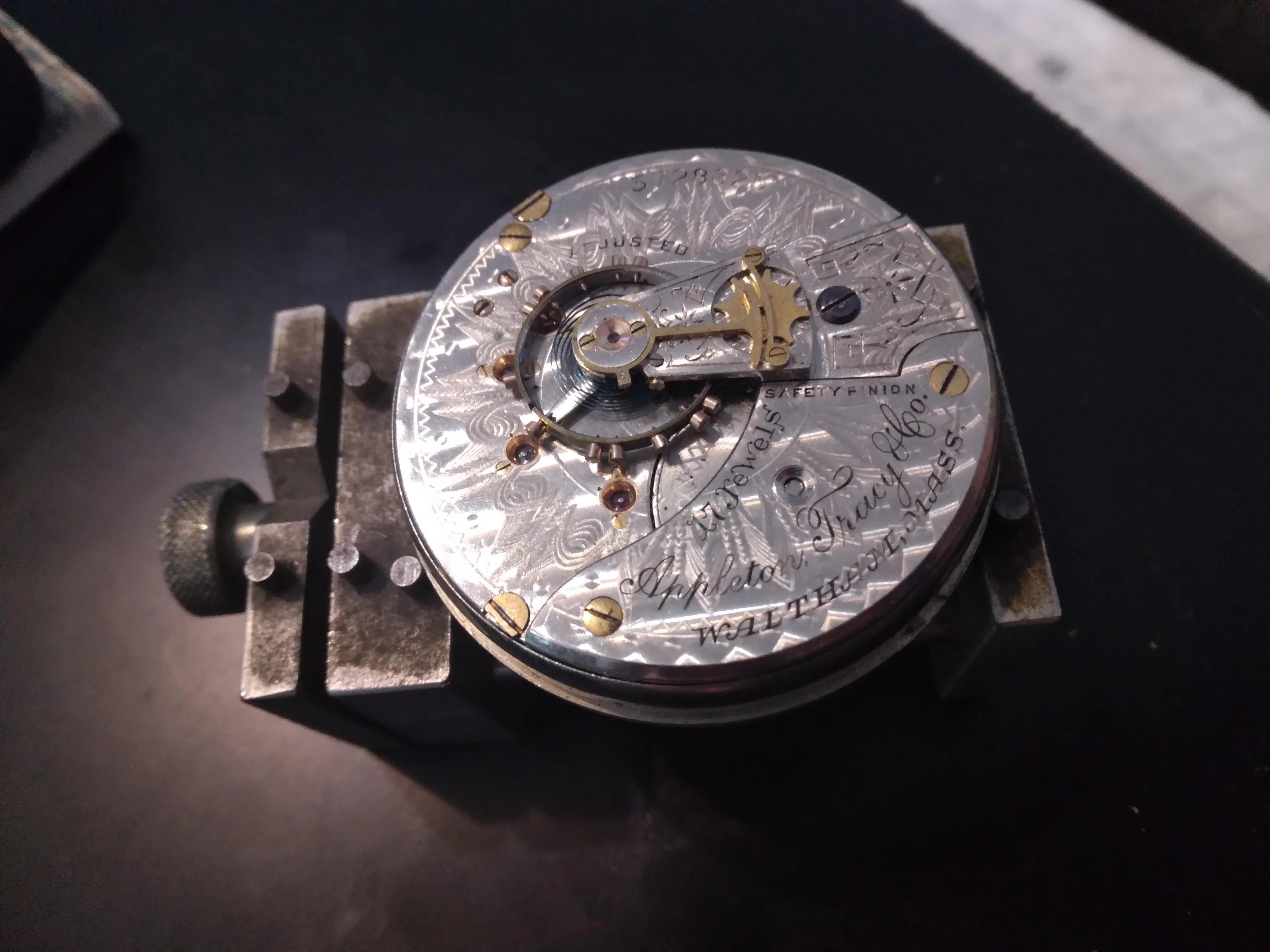 A watchmaker opens the case, checks the movement serial, and assesses condition. At $50 to $150 on a $2,000-plus purchase, it is the cheapest insurance available. Credit: u/armie
Independent watchmaker inspection ($50–$150). A qualified watchmaker opens the watch, examines the movement, checks the serial number on the movement against the case, assesses condition, and gives you a written or verbal report. Find NAWCC-member watchmakers via the NAWCC member directory. The inspection typically takes 24–48 hours.
Photo-based authentication services (WatchCSA and similar services charge $25–$75 for a report based on submitted photos). These are useful for a quick second opinion on listing photos before you travel to see a watch. Their limitation is real: photo authentication cannot catch all movement swaps or internal modifications. A watch can look genuine in photos and have a non-original movement inside. Use photo services as a pre-filter, not a final verdict.
💡 The $50–$150 inspection cost is a line item in your total cost of ownership, not an extra. If you want to see how authentication fits into the full 10-year picture for your specific budget, the First Watch Budget & Total Cost of Ownership Calculator lets you model purchase price, service intervals, insurance, and one-time costs like pre-purchase inspection together. It’s a clearer picture than the sticker price alone.
On any pre-owned purchase above $2,000 from a private seller, the inspection cost is less than 5% of the purchase price. Below $1,500 from a reputable CPO dealer with a published authentication guarantee, the platform’s protection may be sufficient, but you’re still better off running the physical checklist yourself.
What professional authentication does not cover: a watchmaker can confirm the movement is genuine and the case is genuine. They cannot always confirm that the dial, hands, and movement were originally paired together. That’s the franken-watch problem, and it’s a separate risk category.
Frankenwatches: the risk that authentication misses
A franken-watch is not a fake. It is a watch assembled from genuine components that were not originally paired together.
The most common version: a genuine Rolex movement in a genuine Rolex case, but with a dial sourced from a different reference year or a different example. Every component is real. The watch will pass most authentication checks. But it is not an original-configuration example, and the market prices it accordingly.
A Rolex Submariner with a genuine movement and case but a replacement dial from a different production year can trade at a 20–40% discount versus an original-configuration example at the same Chrono24 market rate. On a $4,000 watch, that’s a difference of $800–$1,600. It matters if you ever plan to sell.
What to look for:
The serial number engraved on the movement (where accessible) should be consistent with the case serial. On Rolex, the movement serial and case serial should be from the same approximate production era. A significant mismatch, a movement from 2005 in a case from 2018, for example, is a flag.
The dial printing style should match the production year indicated by the case serial. Rolex dial typography and layout changed across decades. A dial that looks stylistically inconsistent with the case’s production year warrants scrutiny.
The honest limit: franken-watch detection often requires a watchmaker’s inspection. The movement serial is not always accessible without opening the case. This is one of the strongest arguments for the pre-purchase service report on any vintage or older pre-owned purchase, not just to confirm authenticity, but to confirm originality.
“Genuine” and “original configuration” are not the same thing, and the price difference between them is real.
Putting it together
This workflow won’t protect you from every fake. A determined counterfeiter producing super-reps can fool a non-expert, and being honest about that limit is the starting point for using this process correctly.
What the workflow does: it catches the majority of counterfeits a first buyer will encounter, gives you a clear framework for when to bring in a professional, and tells you exactly which conditions are walk-away signals versus which ones are worth investigating further.
The three outcomes, proceed, request a service report, walk away, are what turn a checklist into a decision. A list of things to check is only useful if it ends with a clear action.
If you’re buying pre-owned above $2,000 from a private seller, budget $50–$150 for an independent watchmaker inspection via the NAWCC member directory. Run the physical checklist yourself first. Use Chrono24’s market data to calibrate the price. And if a single walk-away condition is present, walk away, regardless of how good the rest of the watch looks.
The right watch at the right price will pass these checks. If this one doesn’t, another one will.